Choose a wall with a reason
Look at the room from its usual viewpoints: seated on the sofa, entering through the door, or standing at a work surface. Choose a wall that can hold attention without creating visual noise beside an already busy area. A narrow passage might suit one shallow frame better than an elaborate collection.
Consider the furniture before measuring the empty plaster. A picture group above a cabinet should feel connected to that cabinet, rather than floating independently near the ceiling. Avoid relying on a universal hanging height. The right position depends on whether the work is viewed standing, sitting or from across the room.
Leave some walls quiet. A room with several competing displays can make individual objects harder to appreciate. One resolved arrangement often gives more character than a scattering of unrelated pieces across every available surface.
Find the thread in what you own
Gather possible pieces on a clean floor or table. Include photographs, drawings, prints, postcards and textiles, but protect fragile surfaces while handling them. Ask what connects the objects. It might be a repeated warm color, a family story, a shared subject or the weight of dark frames.
The connection need not be literal. A monochrome photograph can sit comfortably beside a textured weaving if their proportions and surrounding space are balanced. Conversely, identical frames cannot make unrelated objects feel meaningful by themselves. Start with content you want to live with rather than buying an instant collection.
Museums offer useful lessons in pacing and contrast. Browse the collections of the Victoria and Albert Museum, Tate or the Museum of Modern Art to notice how scale, materials and visual rhythm change the experience of a group. These institutions are references, not partners or endorsements of this site.
Build the composition on paper
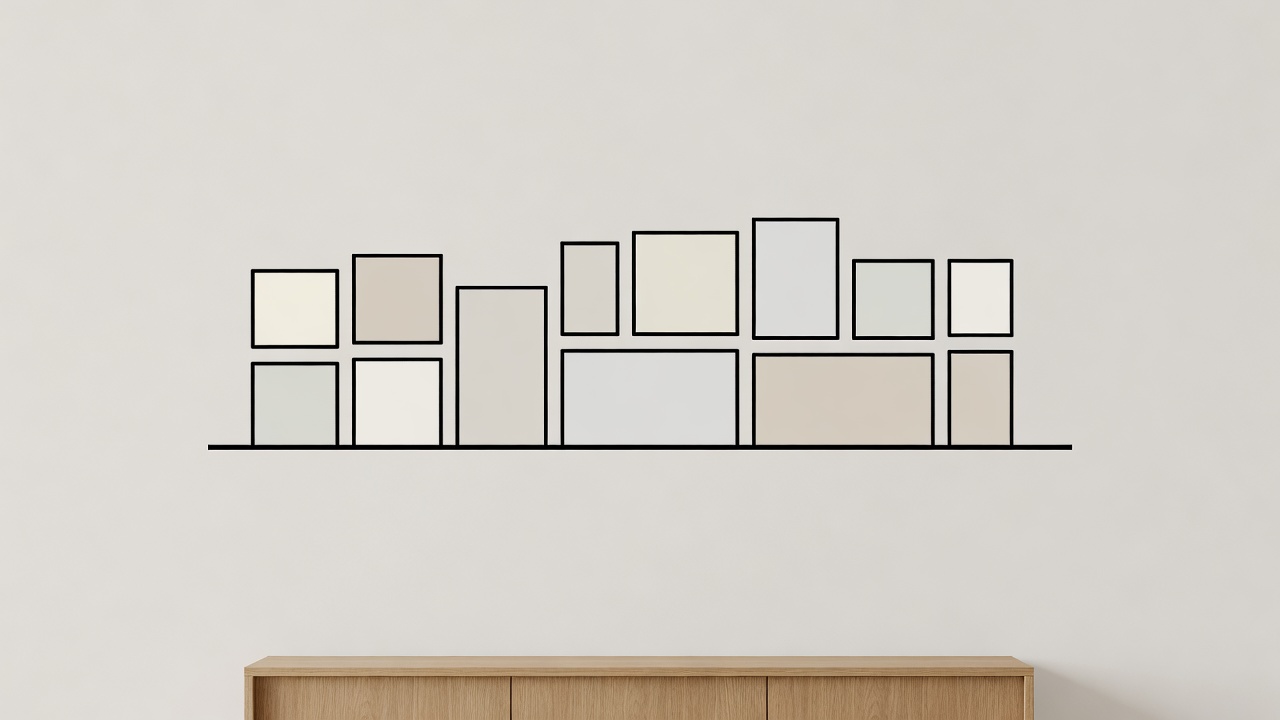
Trace each frame onto paper and mark the hanging point accurately. Arrange the templates using a surface-appropriate temporary method, checking a discreet area first. Photograph two or three versions from the same position. This makes differences easier to judge than repeatedly moving the real objects.
Begin with the largest or most visually assertive piece. Place supporting works nearby, then check the outer silhouette of the group. You can use a shared center line, a common lower edge or a looser cluster with reasonably consistent gaps. Do not force several organizing systems into the same small display.
Step back and inspect the spaces between objects. A narrow gap beside a wide gap can look accidental unless another relationship explains it. Equally, rigid spacing may feel awkward when one object has an irregular shape. Aim for an intentional rhythm rather than mathematical perfection.
Consider reflective glass and direct daylight. Check whether a lamp appears as a bright reflection from the sofa. Valuable or light-sensitive works may need specialist framing, glazing and placement advice. Ordinary decorative framing should not be assumed to provide conservation protection.
Install for the actual wall
Identify the wall construction and the complete weight of each framed piece before selecting fixings. Follow the fixing and frame manufacturers’ instructions. If you are uncertain about hidden services, suitable anchors or the wall itself, stop and ask a qualified professional. A decorative plan is not a substitute for safe installation.
Renters should check their agreement and obtain permission where necessary. Adhesive strips are not automatically damage-free: paint condition, surface type, humidity and load all matter. Follow their stated limitations, and do not hang heavy or hazardous objects above beds or seating using an uncertain method.
If drilling is unsuitable, use an existing picture rail with compatible fittings, or display small pieces on a stable cabinet where they cannot fall or be pulled down. A leaning frame still needs a secure position, especially around children and pets. Freestanding does not mean risk-free.
Once the wall is complete, live with it before expanding. Replace or rotate one piece when your interests change instead of continuously enlarging the group. The point is to see the objects clearly and enjoy their company, not to finish every centimeter of wall.